You’ve spent thousands on creams. You’ve tried home remedies your aunt swears by. Maybe you even got a laser session at a clinic in Blue Area that promised results in two weeks. Your acne scars are still there. Staring back at you every morning.
Here’s why: most people in Pakistan are treating the wrong problem with the wrong tool. Acne scar treatment Islamabad clinics often use a one-size-fits-all approach that ignores the most basic rule of dermatology. Different scars need different treatments. Period.
At Ritual Aesthetics in F-8 Markaz, we’ve treated over 1,500 patients since 2015. The pattern is always the same. People come in frustrated after trying everything. We do a proper skin consultation. We map their scar types. We build a custom protocol. Then they finally see results.
Why Most Acne Scar Treatments in Islamabad Fail
Walk into most clinics and they’ll sell you whatever machine they just bought. CO2 laser for everyone. Or microneedling for everyone. Or some new peel they’re pushing this month.

Nobody asks what type of scars you actually have. Nobody explains why a cream physically cannot fill a hole in your skin. Nobody tells you that the dark marks on your cheeks are not even scars at all.
The best treatment for acne scars Pakistan offers is not a single treatment. It’s a layered approach that targets each scar type with the right tool at the right depth. Anything else is just guessing.
Most people waste money because they start treatment without diagnosis. You wouldn’t take antibiotics without knowing which infection you have. Same logic applies here.
Marks vs Scars — Two Completely Different Problems
This is where 70 percent of the confusion happens. Acne marks are flat. They’re just pigmentation left behind after a pimple heals. Post-inflammatory hyperpigmentation fades on its own in three to six months. Sometimes faster with the right products.
Scars are structural damage. The skin is actually dented or raised. Texture changes you can feel with your finger. No amount of vitamin C serum will fix that.
Marks need brightening treatments like chemical peels or topical retinoids. Scars need procedures that rebuild collagen deep in the dermis. Mixing these up is expensive.
Know Your Scar Type First
Here’s what separates clinics that actually get results from clinics that just take your money. Proper scar assessment before any treatment starts.
Most Pakistani patients have a mix of three different scar types on their face. Ice pick scars on the cheeks. Rolling scars near the jawline. Boxcar scars on the temples. Each one formed differently. Each one needs a different approach.
Treating them all the same way is like using the same key for three different locks. It doesn’t work.
Ice Pick, Rolling, and Boxcar — Why They Each Need Different Treatment
Ice pick scars are narrow and deep. They look like someone poked your skin with a sharp tool. These go all the way down into the dermis. Surface treatments like light peels or microneedling barely touch them.
Rolling scars create a wavy texture. They happen when fibrous bands form underneath the skin and pull it down. The solution is not resurfacing the top layer. You need to release those bands first.
Boxcar scars have defined edges and a flat bottom. They’re wider than ice picks but not as deep. Shallow boxcar scars respond well to fractional lasers. Deep ones need volume restoration or skin resurfacing combined with other methods.
Nobody has just one type. Your left cheek might have mostly ice picks. Your right cheek might have rolling scars. Temples might show boxcars. A proper assessment maps all of this before recommending anything.
TCA Cross treatment Pakistan dermatologists use is specifically designed for ice pick scars. It chemically destroys the scar tract so new collagen fills it from the bottom up. Using TCA Cross on rolling scars does nothing.
Why One Treatment Cannot Fix All Three
Each scar type has a different anatomy. Ice picks are deep and narrow. Rolling scars are wide and tethered underneath. Boxcars are angular with specific depth variations.
One laser setting cannot address all three. One needle depth cannot reach all three. This is why Ritual Aesthetics uses combination protocols built around your specific scar pattern.
A typical treatment plan here might include subcision for rolling scars, TCA Cross for ice picks, and fractional laser for boxcars. Layered over six to twelve months. Adjusted based on how your skin responds.
Cookie-cutter protocols fail because skin is not uniform. Scar depth is not uniform. Skin type varies. A foreign-qualified dermatologist with proper training knows this.
Treatment Protocols That Actually Work (Best Treatment for Acne Scars Pakistan)
Let’s talk about what actually works. Not the marketing language clinics use. Real treatment protocols based on scar type and severity.
The best treatment for acne scars Pakistan clinics offer is not one procedure. It’s a planned sequence of treatments designed to rebuild skin architecture from the inside out. Here’s how that breaks down.
CO2 Laser for Scars — When It Works and When It Does Not
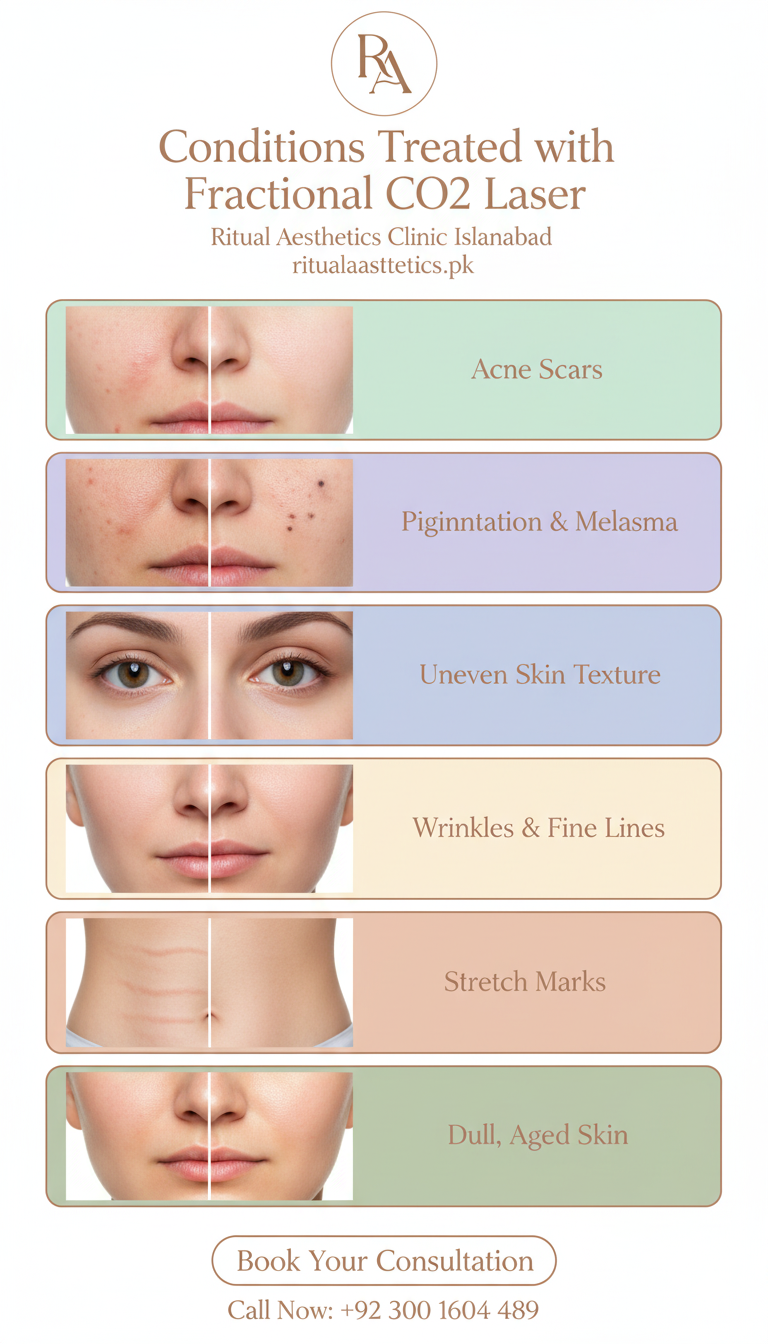
CO2 laser for scars Islamabad providers use creates controlled damage to the skin surface. Your skin responds by producing new collagen. Over weeks, texture improves and scar depth reduces.
This works best for boxcar scars and mild rolling scars. The laser vaporizes the damaged top layer and triggers deep collagen remodeling underneath. Results show up gradually over three to six months.
Here’s the catch. CO2 laser alone does not fix deep ice pick scars. It smooths the surface but cannot fill a narrow vertical channel. You need TCA Cross or punch excision for those.
Pakistani skin (usually Fitzpatrick Type IV or V) carries higher risk for post-inflammatory hyperpigmentation after aggressive CO2 treatment. A skilled dermatologist adjusts settings to minimize this. Inexperienced providers leave you with dark patches that take months to fade.
Fractional laser is a safer option for darker skin tones. It treats micro-columns of skin instead of the entire surface. Less downtime. Lower PIH risk. Slightly slower results but much safer long term.
Microneedling and RF Microneedling — The Collagen Trigger
Microneedling for scars works by creating thousands of controlled micro-injuries. Your skin interprets this as damage and floods the area with growth factors. Collagen production ramps up. Scar depth reduces over time.
Standard microneedling reaches the upper dermis. Good for mild scars and skin texture improvement. Pair it with PRP (platelet-rich plasma) and healing speeds up significantly. Ritual Aesthetics offers Microneedling with PRP at PKR 20,000 per session.
RF Microneedling adds radiofrequency energy to the needles. Heat penetrates deeper into the dermis. This triggers more aggressive collagen remodeling than regular microneedling. Better for moderate scars. Available here at PKR 6,000 per session.
Neither treatment works in one session. Expect four to six sessions spaced four weeks apart. Results start showing around session three. Full improvement takes six months after the last session.
Subcision and Fillers — For Rolling Scars Specifically
Rolling scars are caused by fibrous bands that tether the skin down. No amount of surface treatment will fix that. You have to release the bands first.
Subcision uses a small needle inserted under the scar. The dermatologist moves it back and forth to cut the fibrous tissue. Skin lifts up. Sometimes immediately. Sometimes over weeks as swelling goes down and collagen fills the space.
Dermal fillers can be injected right after subcision to restore volume. This gives instant lift while your body builds new collagen underneath. Works especially well for deep rolling scars on the cheeks.
Combining subcision with fillers and then following up with RF Microneedling or fractional laser gives the best results for rolling scars. That’s a proper protocol. Not just throwing one treatment at everything.
What to Expect — Real Timelines and Real Results
Let’s set realistic expectations. Clinics that promise 100 percent scar removal in one month are lying. Collagen remodeling takes time. Skin regeneration is slow.
Mild scars take three to six months of consistent treatment. You’ll see 60 to 80 percent improvement if you follow the protocol and maintain results. Some scars might fade completely. Deep ones will improve but not vanish.
Moderate scars need six to twelve months. Expect 50 to 70 percent improvement. You’ll need combination therapy. Maintenance sessions every few months keep results stable.
Severe scarring takes twelve to eighteen months. Improvement ranges from 40 to 60 percent. Deep ice picks and tethered rolling scars are stubborn. But even 50 percent improvement changes how your skin looks in natural light.
Dark marks fade faster than structural scars. Pigmentation responds to peels and topical treatments in weeks. Textured scars need months of dermis-level remodeling.
One thing nobody talks about: Islamabad’s climate affects healing. Monsoon humidity increases infection risk after procedures. Summer sun exposure triggers pigmentation even with sunscreen. Timing treatments around weather makes a difference. Your dermatologist should plan around this.
Ready to Stop Guessing?
If you’ve been trying treatments based on Instagram ads or friend recommendations, stop. Acne scars are complex. Scar types vary. Skin types vary. One-size-fits-all fails every time.
A proper skin consultation at Ritual Aesthetics in F-8 Islamabad gives you an accurate scar assessment and a custom plan built for your specific scarring pattern. FDA-approved technology. Foreign-qualified specialists. Personalized protocols since 2015.
Call +92 300 1604489 or visit ritualaesthetics.pk to book. First Floor, Bakeman Plaza, Kohistan Double Road, F-8 Markaz. Monday to Saturday, 12 PM to 9 PM.
FAQ
What is the best treatment for acne scars in Pakistan?
There is no single best treatment. It depends on your scar type. Ice picks need TCA Cross or punch techniques. Rolling scars need subcision. Boxcars respond to fractional lasers. Most people need a combination approach over several months.
How much does acne scar treatment cost in Islamabad?
Pricing varies by treatment type. RF Microneedling starts at PKR 6,000. Microneedling with PRP costs PKR 20,000. Chemical peels range from PKR 6,000 to PKR 8,000. Combination protocols cost more but give better results. Contact Ritual Aesthetics for a detailed quote based on your specific needs.
How many sessions do I need for acne scar removal?
Mild scars need four to six sessions. Moderate scars need six to ten. Severe scarring requires twelve or more sessions spread over a year. Sessions are spaced four to six weeks apart to allow collagen remodeling between treatments.
Can old acne scars be removed?
Old scars can improve significantly but rarely disappear completely. Scar tissue has been there for years. Remodeling takes time. Expect 50 to 70 percent improvement with proper treatment. Some shallow scars might fade entirely. Deep scars will always show some texture.
Is microneedling better than CO2 laser for scars?
Depends on scar depth and skin type. Microneedling is safer for darker skin and has less downtime. CO2 laser gives faster results but carries higher pigmentation risk. Many patients benefit from combining both treatments over time.
What is TCA Cross treatment and how does it work?
TCA Cross uses high concentration trichloroacetic acid applied directly into ice pick scars. It destroys the scar tract. New collagen fills the space from the bottom up. Results appear over three to six months. Multiple sessions are needed for deep scars.
How long does it take to see results from acne scar treatment?
Initial improvement shows in four to six weeks. Significant texture change takes three to six months. Full collagen remodeling completes around twelve months after your last session. Patience is required. Skin regeneration cannot be rushed.
Can acne scars be treated on dark skin in Pakistan?
Yes, but treatment settings must be adjusted. Pakistani skin (Type IV-V) is prone to post-inflammatory hyperpigmentation. Conservative laser settings and proper post-care prevent dark spots. Experienced dermatologists know how to treat darker skin safely. Ask about their experience with your specific skin tone before starting.
Final Wording:
Acne scars are treatable. But only if you start with proper diagnosis and commit to a structured plan. If you’re ready to stop wasting money on random treatments, Ritual Aesthetics is here. Real assessments. Real protocols. Real results.